

The Architecture of Care™
Designing Healthcare Systems That Produce Better Outcomes
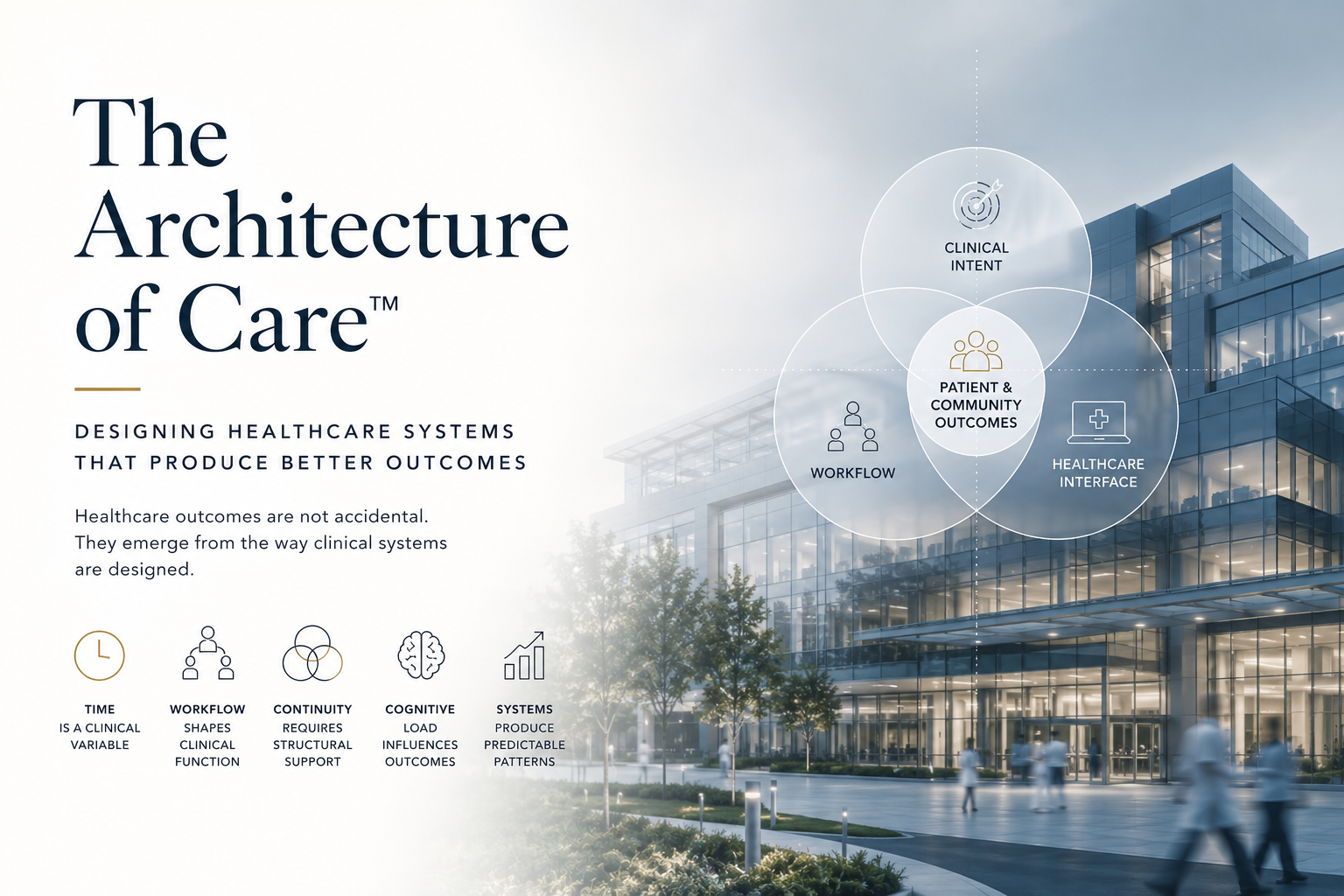
Healthcare outcomes are not accidental. They emerge from the way clinical systems are designed.
The Architecture of Care™ is a systems framework for understanding how healthcare organizations produce clinical, operational, and patient outcomes through the design of their care delivery systems.
Rather than viewing quality, continuity, efficiency, clinician experience, and patient outcomes as independent challenges, The Architecture of Care™ examines how they emerge from the interaction between clinical intent, workflow, and the broader healthcare interface.
At its core, the framework asks a simple but important question:
What kinds of outcomes are our healthcare systems structurally designed to produce?
Vera Nyonglemuga, FNP-BC, FNP-C, CCRN
Founder, Macvelly Wellness & Medical Services
MBA Candidate, UNC Kenan-Flagler Business School (Forté Fellow)
Why The Architecture of Care™ Exists
Modern healthcare has made extraordinary advances in science, technology, and clinical knowledge.
Yet healthcare organizations across the world continue to struggle with many of the same operational challenges:
• fragmented care
• clinician burnout
• documentation burden
• workflow inefficiencies
• communication failures
• cognitive overload
• inconsistent continuity
• variable patient experiences
These challenges are often addressed individually.
Additional staffing.
New technology.
New documentation requirements.
Additional quality initiatives.
More meetings.
More policies.
While each intervention may address part of the problem, many underlying issues remain because they originate from something deeper:
the architecture of the system itself.
The Architecture of Care™ proposes that healthcare outcomes are shaped not only by clinical expertise, but also by how healthcare systems are intentionally—or unintentionally—designed.
The Core Framework
Better Outcomes Begin With Better Alignment
The Architecture of Care™ is built around three interconnected dimensions.
Clinical Intent
Every healthcare system begins with an intended purpose.
Improving health.
Preventing disease.
Supporting recovery.
Reducing suffering.
Delivering safe, evidence-based care.
Clinical intent represents what the organization is trying to achieve.
Workflow
Intent alone does not produce outcomes.
Workflow determines how care is actually delivered.
It shapes:
• communication
• coordination
• decision-making
• documentation
• responsibility
• transitions of care
• patient follow-through
Workflow is the operational expression of clinical intent.
The Healthcare Interface
Healthcare does not operate in isolation.
Clinical work occurs within a larger environment shaped by:
• technology
• electronic health records
• reimbursement models
• regulations
• organizational incentives
• staffing structures
• artificial intelligence
• operational priorities
These external forces influence how care is ultimately experienced by both patients and clinicians.
Patient & Community Outcomes
When these three dimensions remain aligned, healthcare systems are more likely to produce:
• better patient outcomes
• stronger continuity
• improved clinician experience
• operational reliability
• sustainable care delivery
Because outcomes are designed—not accidental.
Five Foundational Principles
The Architecture of Care™ is grounded in five foundational principles.
1. Time Is a Clinical Variable
Time is more than a scheduling resource.
It influences diagnostic reasoning, patient education, interpretation, care coordination, continuity, and longitudinal planning.
Healthcare systems frequently measure productivity in units of time while overlooking the clinical value that time itself creates.
The Architecture of Care™ views time as a foundational element of healthcare design.
2. Workflow Shapes Clinical Function
Clinical expertise operates within workflow.
Even highly skilled clinicians are influenced by interruptions, fragmented communication, documentation requirements, scheduling structures, and operational design.
Workflow does not simply organize care.
It shapes how care is delivered.
3. Continuity Requires Structural Support
Continuity is often described as a relationship.
It is also an operational capability.
Meaningful continuity depends upon systems that preserve information, responsibility, communication, and follow-through across encounters and care settings.
Without structural support, continuity becomes dependent upon individual effort.
4. Cognitive Load Influences Outcomes
Healthcare increasingly relies upon human cognition.
Every interruption.
Every inbox message.
Every task switch.
Every fragmented workflow.
Each consumes clinical attention.
Cognitive load should therefore be considered an operational design variable—not merely an individual resilience issue.
5. Healthcare Systems Produce Predictable Patterns
Recurring organizational challenges are rarely random.
Patterns emerge from:
• workflow design
• incentive structures
• staffing models
• communication systems
• documentation architecture
• operational priorities
Understanding these patterns allows organizations to move beyond reactive problem-solving toward intentional systems design.
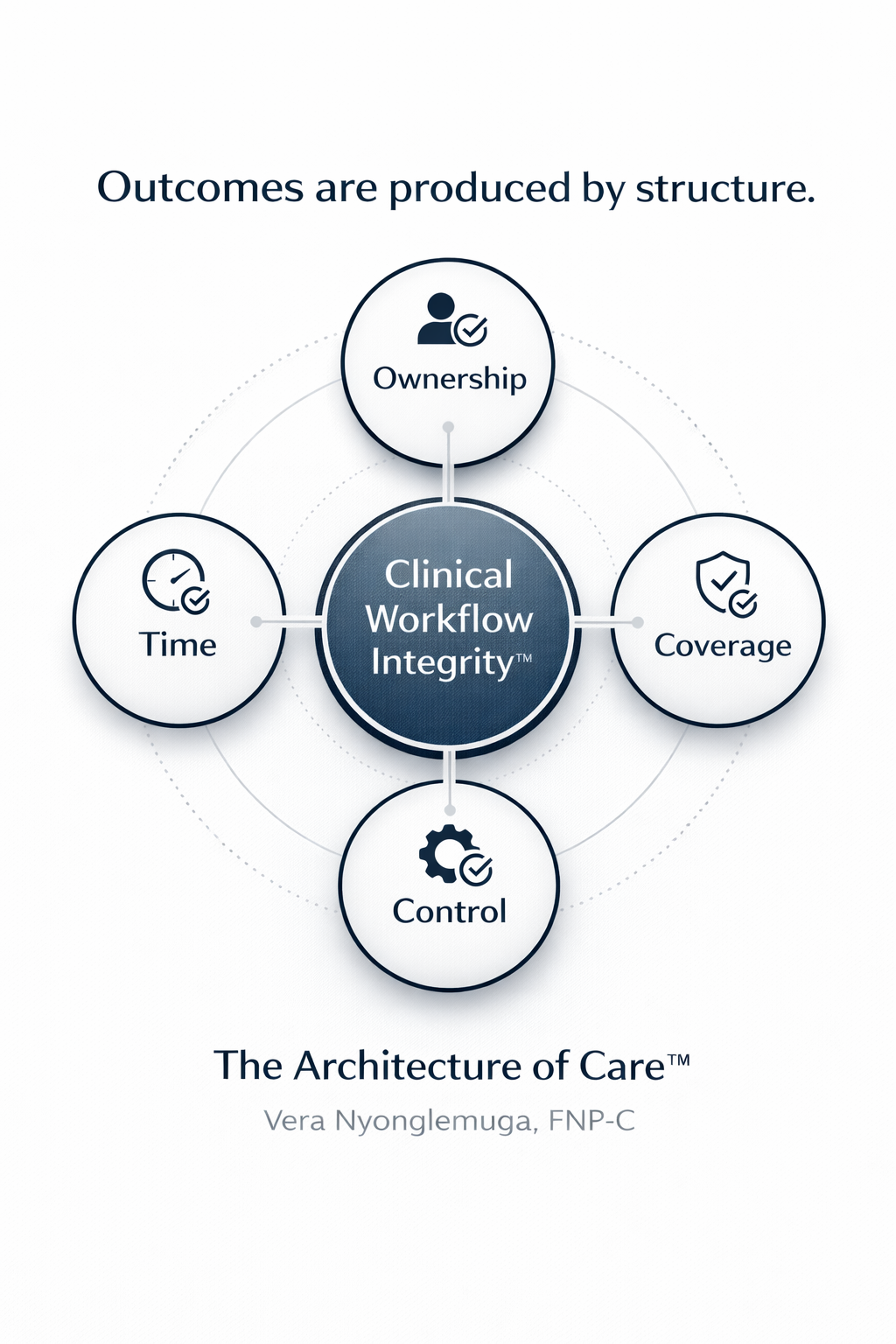
Clinical Workflow Integrity™
One of the foundational concepts within The Architecture of Care™ is Clinical Workflow Integrity™.
Clinical Workflow Integrity™ describes the degree to which clinical intent, workflow, communication, documentation, responsibility, and operational structures remain aligned throughout the delivery of care.
When workflow integrity is preserved:
• continuity improves
• communication becomes more reliable
• cognitive burden decreases
• clinical interpretation becomes more consistent
• patient care becomes more sustainable
When integrity deteriorates, healthcare systems increasingly depend upon clinicians to compensate for structural shortcomings through additional cognitive and emotional effort.
Why This Matters
Healthcare is entering a period of unprecedented complexity.
Artificial intelligence.
Digital transformation.
Increasing chronic disease.
Growing operational pressures.
Workforce shortages.
Expanding patient expectations.
These challenges cannot be solved through productivity alone.
They require healthcare systems intentionally designed to support human clinical reasoning, sustainable workflow, and longitudinal care.
The Architecture of Care™ contributes to that conversation by providing a systems-oriented framework for understanding how healthcare organizations produce outcomes—and how those systems can evolve.
Areas of Exploration
• Clinical Workflow Integrity™
• Time Architecture™
• Continuity Systems
• Healthcare Operations
• AI Integration
• Human-Centered System Design
• Cognitive Sustainability
• Longitudinal Care Models
• Healthcare Communication
• Preventive Care Design
• Organizational Alignment
• Healthcare Strategy
About The Work
The Architecture of Care™ represents an ongoing body of work at the intersection of clinical medicine, healthcare operations, organizational systems, and healthcare strategy.
It is informed by frontline clinical experience, systems observation, healthcare leadership, and continuing study of organizational design.
The goal is not simply to critique healthcare systems.
The goal is to contribute to the design of healthcare systems that are more thoughtful, more sustainable, and better aligned with the outcomes they seek to achieve.
Bridging Clinical Care & Systems Thinking
The Architecture of Care™ sits at the intersection of:
clinical medicine
healthcare operations
workflow design
organizational systems
longitudinal care
and human-centered healthcare strategy.
This work is informed by:
frontline clinical experience
systems observation
operational analysis
longitudinal care philosophy
and ongoing study in healthcare strategy and organizational design.
The goal is not simply critique.
The goal is helping create more thoughtful, sustainable, and clinically aligned systems of care.
System Alignment and Outcome Production
These layers function as an interconnected system.
When misaligned:
continuity breaks down
information fragments
decisions become reactive
outcomes vary
When aligned:
care becomes longitudinal
patterns are recognized earlier
decisions are informed
outcomes improve by design
What Changes When Care Is Designed Differently
When systems are structured with alignment and continuity:
Continuity is built into scheduling—not left to chance
Care ownership is clearly defined
Follow-up is structured and expected
Clinical information persists across encounters
Decision-making becomes more precise
Care shifts from:
episodic → longitudinal
reactive → proactive
fragmented → integrated
Application Across Healthcare Systems
The Architecture of Care™ can be applied across healthcare environments to address structural challenges, including:
Designing continuity-centered care models
Aligning workflows with long-term outcomes
Reducing fragmentation across care settings
Integrating metabolic and hormonal health into longitudinal care
Building scalable models for chronic disease and midlife health
Perspective
This framework was developed from within clinical practice—not as an external critique, but from direct experience working inside the systems it seeks to improve.
The challenges observed were not primarily issues of effort, knowledge, or intent.
They were structural.
Improving outcomes requires redesigning the systems that produce them.
Healthcare outcomes are not accidental.
They are designed.
Understanding the structure of care is the first step.
→ Explore how alignment determines outcomes:
Clinical Workflow Integrity™
Looking Ahead
Healthcare has entered an era where improving outcomes depends not only on advancing medical science, but also on improving the architecture through which care is delivered.
The Architecture of Care™ exists to explore that challenge.
Because the future of healthcare will be shaped not only by what clinicians know—
but by the systems that support how they care.